

A Future Physician's Vision for Whole-Person Care
September 8, 2026
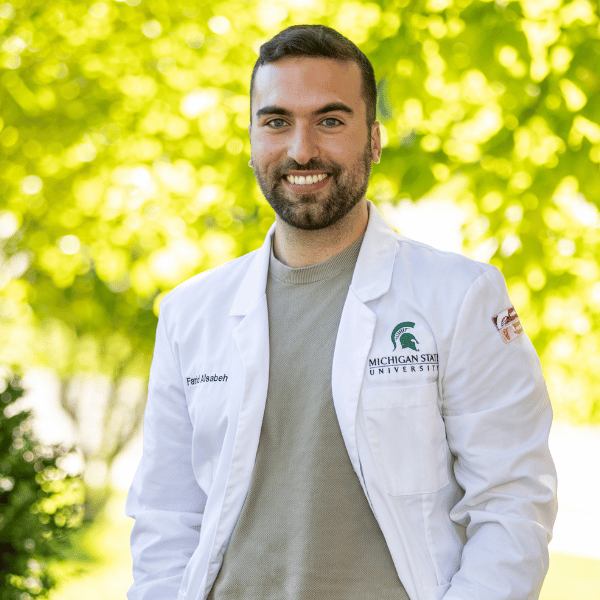 Farid Alsabeh has always been drawn to helping people and solving complex problems. That’s why he chose to study psychology. While working as a master’s level psychologist at the Arab Community Center for Economic and Social Services (ACCESS) in Dearborn, he worked beside primary care physicians and psychiatrists.
“My clients would come to me for psychotherapy, then go to their physicians just across the parking lot. It often felt like they were getting 'two halves' of care — the emotional side, then the medical side.”
The realization prompted Alsabeh to consider becoming a physician to fully live out his desire to become a healer, both body and mind. The decision to pursue medicine became firm after a routine activity with a client turned into a medical emergency.
“He (the client) reported that he felt chest tightness and requested to stop the activity,” said Alsabeh. “I assumed that he was having a strong emotional reaction to the exercise — something that had happened with other clients in the past. But 15 minutes later, he was still having chest pain and was starting to sweat profusely.”
Alsabeh recognized his client’s reaction wasn't psychological, but physical. The patient was having a heart attack. He was able to get him help, and 30 minutes later his client underwent an emergency heart catheterization at a nearby hospital.
With three years of providing psychotherapy to clients under his belt, Alsabeh entered the College of Human Medicine as a Dean’s Scholar. As part of the college’s service-driven mission, students are required to complete volunteer hours as part of their curriculum. Alsabeh was assigned to prepare meals at Gilda’s Club Grand Rapids, a free emotional health support community of patients, their friends, and family navigating cancer journeys alongside those grieving a death due to any cause. He recognized the nonprofit as a place with a mission not unlike his own. A place that supports reaching beyond physical health and addressing the emotional, social, and psychological needs that are essential to healing and well-being.
Leaning on his psychology training, Alsabeh started leading presentations for Gilda’s Club Grand Rapids support groups on topics ranging from stress management to sleep hygiene. A year later, he began biweekly workshops teaching a mindfulness-based meditation technique known as mindful detachment.
"We are so grateful to Farid for bringing his expertise and compassion for others to Gilda's Club Grand Rapids. Through his workshop, members have learned how to manage some of their distress while navigating a cancer and/or grief journey. Anyone who talks with Farid feels his compassion and sincerity to help others."
- Clare Portinga, VP Program
The sessions are split into two parts. The theoretical part, where the idea that anxiety is the result of rigid, maladaptive patterns of engagement with the mind is established. And the practical part, where participants are trained to 'detach' from any kind of engagement with their own minds.
“I often describe this as a kind of muscle,” said Alsabeh. “When we exercise this muscle during the practice, we become capable of using it when we need to, allowing us to break free of the rumination that is often the hallmark of anxiety.”
Alsabeh sees his sessions as a way to connect with people and achieve his goal of becoming a humanistically-oriented doctor.
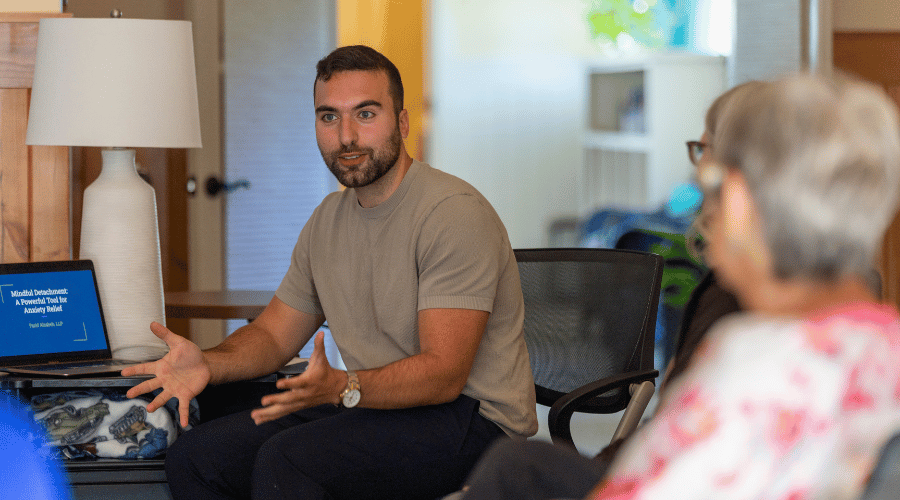
“A physician is first and foremost a caretaker, not only to individual patients but also to their community,” said Alsabeh. “Their knowledge and skills are applied in service to their responsibilities as caretakers.”
Alsabeh believes upholding the humanistic paradigm will become more important than ever as medicine encounters unprecedented circumstances like those posed by managed care and AI.
He credits becoming a Dean’s Scholar with giving him the freedom to pursue interests and projects, like those through his private practice Steady Mind, PLLC, that require time and money while he completes his medical school journey.
“It’s opened up new opportunities for connection and collaboration that wouldn't have otherwise been available to me,” said Alsabeh. “Ultimately, it has empowered me to develop paradigms of healthcare that integrate both mental and physical health, creating the impact that I want to have as a medical student and as a future physician.”
"We are grateful that the MSU CHM volunteer opportunity connected Farid and other medical students with the program here at Gilda's Club Grand Rapids. It's mutually beneficial for the medical students to learn about the free cancer and grief support resources available through Gilda's Club Grand Rapids for patients and families, and for Gilda's Club Grand Rapids members to learn from medical experts."
- Lindsay Jousma, Director of Program Operations & Relations
By Emily Linnert